
Speech of the UN Humanitarian Coordinator, Mr. George Conway on World Humanitarian Day, 2026.
Remarks as delivered.
Honourable Commissioner of SODMA,
Colleagues, Humanitarian workers, and Partners
Today, on World Humanitarian Day, we come together to honour the people who stand at the front lines of humanitarian action.
We honour their courage and their dedication. And we remember those who have lost their lives while trying to save the lives of others.
This year’s global theme, #ActForHumanity, could not be more timely.
Around the world, humanitarian workers are facing growing risks. In 2025 alone, 350 aid workers were killed, 322 injured, and 235 kidnapped globally. So far this year, 82 humanitarian workers have been killed, 97 injured and 39 kidnapped.
Behind every one of these numbers is a person. A colleague. A mother or father. A son or daughter. A friend. And behind every person lost, is a family whose life has been changed forever.
But there is another dimension to these attacks that we cannot forget. When humanitarian workers are attacked or prevented from reaching people in need, its civilians who ultimately pay the price. A humanitarian worker who cannot safely reach a health facility, means a patient may not receive treatment. A convoy that cannot reach a community means food, water or other essential supplies may not arrive. A programme suspended because of insecurity means families already facing crisis are left without support. This is why protecting humanitarian workers is not simply about protecting those who deliver assistance. It is about protecting the right of people in crisis to receive assistance and protection.
Colleagues, in Somalia, humanitarian workers serve on the front lines of a complex crisis. An estimated 4.8 million people require humanitarian assistance in 2026, as communities continue to face the combined effects of drought, conflict, displacement and disease.
Following prolonged drought, humanitarian partners are now preparing for the potential impacts of El Niño-related flooding later this year. Communities that have already endured repeated shocks have very little room to absorb another major crisis.
In this environment, humanitarian workers are often serving in difficult and dangerous conditions to reach people who have nowhere else to turn.
Access remains difficult. In the second quarter of this year alone, 41 incidents impeding humanitarian access were reported across Somalia.
Roughly one-third of these involved military operations and on-going hostilities impeding humanitarian action. Another third involved violence or threats against humanitarian personnel. Interference in humanitarian activities accounted for a further 22 per cent.
These are not simply statistics. They have real consequences. They disrupted site assessments. They delayed programmes. They constrained road and air movements. And in some locations, they prevented or delayed essential services from reaching communities.
When humanitarian workers are attacked, or prevented from reaching people in need, its civilians who ultimately pay the price. Families lose access to food, clean water, healthcare and protection.
Every such incident creates another barrier between people in need and the assistance they depend on.
Humanitarian workers are protected under international humanitarian law, and those protections must be respected. They are not optional. All parties must respect their obligations under international law. Humanitarian personnel, facilities and assets must be protected. Civilians and civilian infrastructure must be safeguarded. And humanitarian organisations must be able to reach people in need rapidly, safely, sustainably and without hindrance.
And we must also be clear about accountability.
Those responsible for attacks against humanitarian personnel and humanitarian operations must be held accountable. Impunity risks normalising violations, placing aid workers and civilians at even greater risk, and making it harder to deliver assistance to communities who need it most. And tremendous thanks and appreciation to SODMA, the Commissioner, and the FGS.
Today, I want to pay particular tribute to the dedication and courage of humanitarian workers across Somalia, particularly Somali aid workers and local responders who form the backbone of the humanitarian response.
Every day, they work in difficult and often dangerous conditions to reach people in desperate need. Their commitment saves lives and gives hope to millions of vulnerable Somalis.
They are often among the first to respond when a crisis strikes. They know the communities they serve. They understand local realities. And they continue working long after international attention has moved elsewhere.
They do this every day, often under extraordinary pressure and at considerable personal risk.
To all humanitarian workers across Somalia: Your work saves lives. It protects dignity. And it gives people hope.
Gratitude, however, is not enough. Expressions of concern are not enough.
Where violations occur, we need accountability. At the same time, humanitarian action must remain adequately supported so that humanitarian organizations have the resources, personnel and capacity to reach people in need.
And so: The message of this year's World Humanitarian Day is simple:
Communities in crisis need access to assistance. Humanitarian workers need protection. Violations require accountability. On this World Humanitarian Day, we must do more than speak about humanity. We must act for humanity.
Behind every humanitarian worker is a human being. And behind every humanitarian worker is a community that depends on humanitarian action.
Let us honour those who serve. Let us remember those we have lost.
And, most importantly, we must continue, with full conviction and solidarity, to act for humanity.
Thank you very much.


Speech by
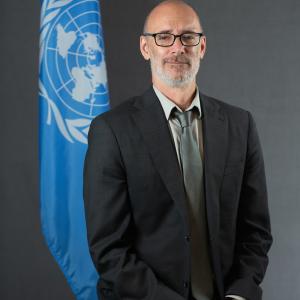
George Conway
Goals we are supporting through this initiative


